Overview
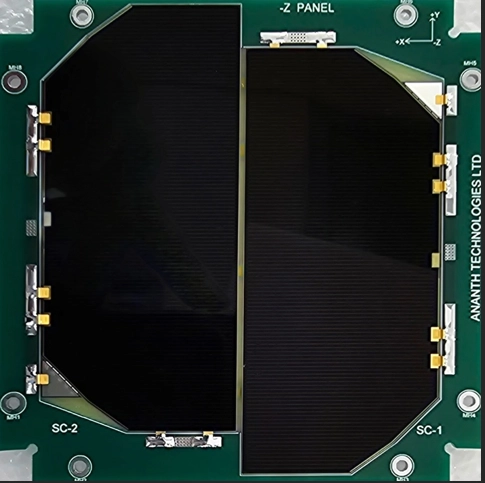
Ananth Technologies designs and manufactures high-performance solar panels for satellites ranging from CubeSats to advanced microsatellites. Developed at our Bengaluru space hardware facility, our solar panels combine flight-proven materials, precision engineering, and comprehensive environmental testing to deliver reliable power generation in demanding orbital conditions.
Key Features
High-Efficiency Triple-Junction Solar Cells
- GaInP/GaInAs/Ge triple-junction cells from leading international suppliers
- Efficiency up to 31%
- Integrated cover glass for radiation and particulate protection
Robust Electrical Design
- Magnetically clean layout to minimise dipole effects
- Parallel Gap resistance welding technique for solar cell interconnection
- Customizable string configurations (parallel / series)
- Built-in bypass and isolation diodes for shading protection
- Low-outgassing RTV silicone adhesive for solar cell bonding
Precision Mechanical Structures
- Multiple substrate options: PCB / FR-4 for CubeSats, CFRP plate + FR4 flex for larger configurations
- Aluminium honeycomb with CFRP face skins for microsatellite and large-format panels
- Space-grade hinges, hold-and-release mechanisms, and deployment systems
Customizable Interfaces
- Flexible mounting hole patterns and panel dimensions
- External temperature sensors with configurable I²C addresses
- Micro-D electrical connectors with custom bracket options
Applications
- Communication satellites
- Earth observation satellites
- Navigation satellites
- Scientific missions
- CubeSats and nanosatellites
- LEO constellations
Specifications
- Cell Type: Triple-junction GaAs
- Efficiency: Up to 31%
- Operating Temp: -60°C to +110°C
- Radiation Tolerance: 1E15 e/cm²
- Mission Life: 15+ years
- Large Panel Size: Up to 1.5m × 2.5m
- Power Density: ~230-250 W/m²
Testing & Qualification
Every solar panel undergoes rigorous qualification and acceptance testing, ensuring mission reliability from launch through long-duration space operations.
- Visual, dimensional, and mass verification
- Continuity & insulation resistance testing
- Electro-luminescence (EL) imaging for solar cell micro crack detection
- Vibration & mechanical shock tests
- Thermal vacuum and thermal cycling
- Sun simulator (I–V curve) testing
- Post-environmental functional performance testing
Product Portfolio
CubeSat Solar Panels (1U–16U)
Substrate: PCB, 2 cells in series, Pmax: ~2W, Size: 83 × 103.2 mm
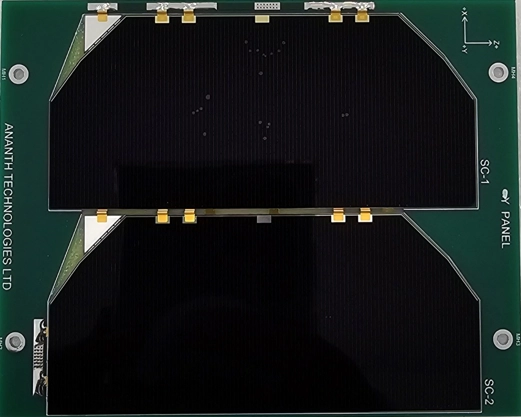
Size: 206.5 × 321.3 mm, Substrate: FR-4, 5S × 3P configuration
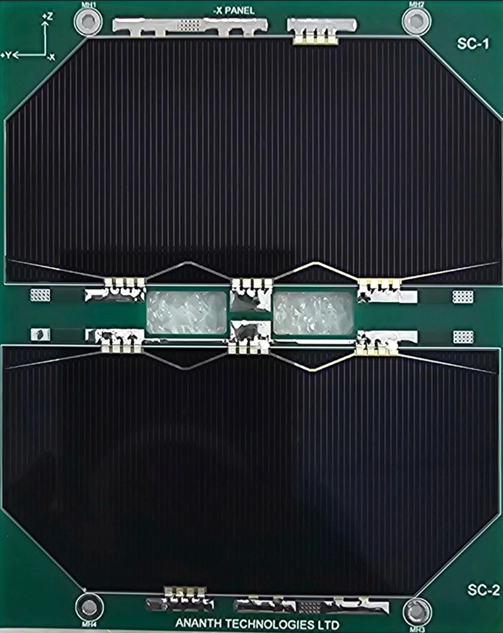
CFRP plate + FR-4 flex circuitry, Size: 336 × 205 mm
Microsatellite Solar Arrays
Customised deployable solar arrays for microsatellites up to the 100-kg class and beyond.
- Aluminium honeycomb core with CFRP face sheets
- Precision-engineered hinges and deployment mechanisms
- Temperature sensors, sun sensors, and isolation diodes integrated
- Deployed frequency greater than 2 Hz for stability
Large-Format Satellite Solar Panels
For advanced satellites requiring high power, based on aluminium honeycomb structures with CFRP skins.
- Dimensions up to 1.5 m × 2.5 m
- Power Output: ~230-250W per square meter
- Lightweight: ~2 kg per square meter of array blanket mass
- Optimal balance of stiffness, weight, and performance
Customization Capabilities
Whether for a CubeSat, micro-satellite, or a next-generation LEO constellation, Ananth delivers solar panels precisely tailored to mission requirements.
- Panel geometry and size
- Solar cell type and configuration
- Deployable array mechanisms
- Connector and harness layout
- Mechanical interfaces and hinge systems
- Thermal design and sensor integration
- Full documentation, testing, and qualification support